Download your lesson workbook · Open the assignment tool →
Your ASO learning objective
Compare competitor positioning without mistaking visible listing claims for verified demand or product performance.
- Step 1Select comparable product jobs
- Step 2Record claims and visible proof
- Step 3Decide what to adopt, clarify or exclude
Choose comparators by the job they address
Select a small set of apps that a user might consider for the same task, plus one adjacent alternative if it helps clarify the boundary. Brand familiarity alone is a weak selection rule. Explain why each app belongs in the comparison and record the store, locale and observation date. A listing can change, so a later reviewer needs to know which version of the evidence you saw.
For Trail Notes, a hiking journal is a direct comparison; a route navigator is an adjacent alternative. Comparing them can reveal expectation risks, but it does not mean the journal should copy navigation language. The matrix should explain which user jobs overlap and where they diverge.
Record visible claims before interpreting them
Copy a short relevant claim into the observation record and identify its listing source. Describe the screen or creative element that supports your observation: for example, “opening screenshot shows a route map” rather than “their conversion is strong.” Public creative does not reveal a competitor’s conversion rate, retention or profitability.
Separate the audience addressed, feature emphasized, creative approach, unknowns and your own positioning decision. If you have not used the product, do not claim to have verified its functionality. A visible listing claim can still generate a useful research question, provided the gap remains explicit.
Convert comparisons into decisions for your app
Look for recurring language, differences in the product argument and expectations your app must clarify. Send a non-brand phrase to the Keyword Workbench as a pending candidate, linking the competitor observation ID. Then apply the same relevance test as any other candidate. Avoid copying protected names, unverifiable superiority claims or promises your product cannot demonstrate.
Worked example: Trail Notes
This fictional hiking-journal app and its review samples are the teaching project. Treat the example as a reasoning exercise you can adapt to your own evidence.
- Original draftRoute Beacon leads with a map, so Trail Notes should target offline navigation.
- Revised proposalRoute Beacon’s fictional listing addresses directions. Trail Notes should clarify its personal-journal purpose and investigate journal-related language instead.
- Why it changesThe comparison identifies a positioning boundary. A competitor’s visible message is evidence of that message, not proof that copying it is appropriate.
Your ASO assignment
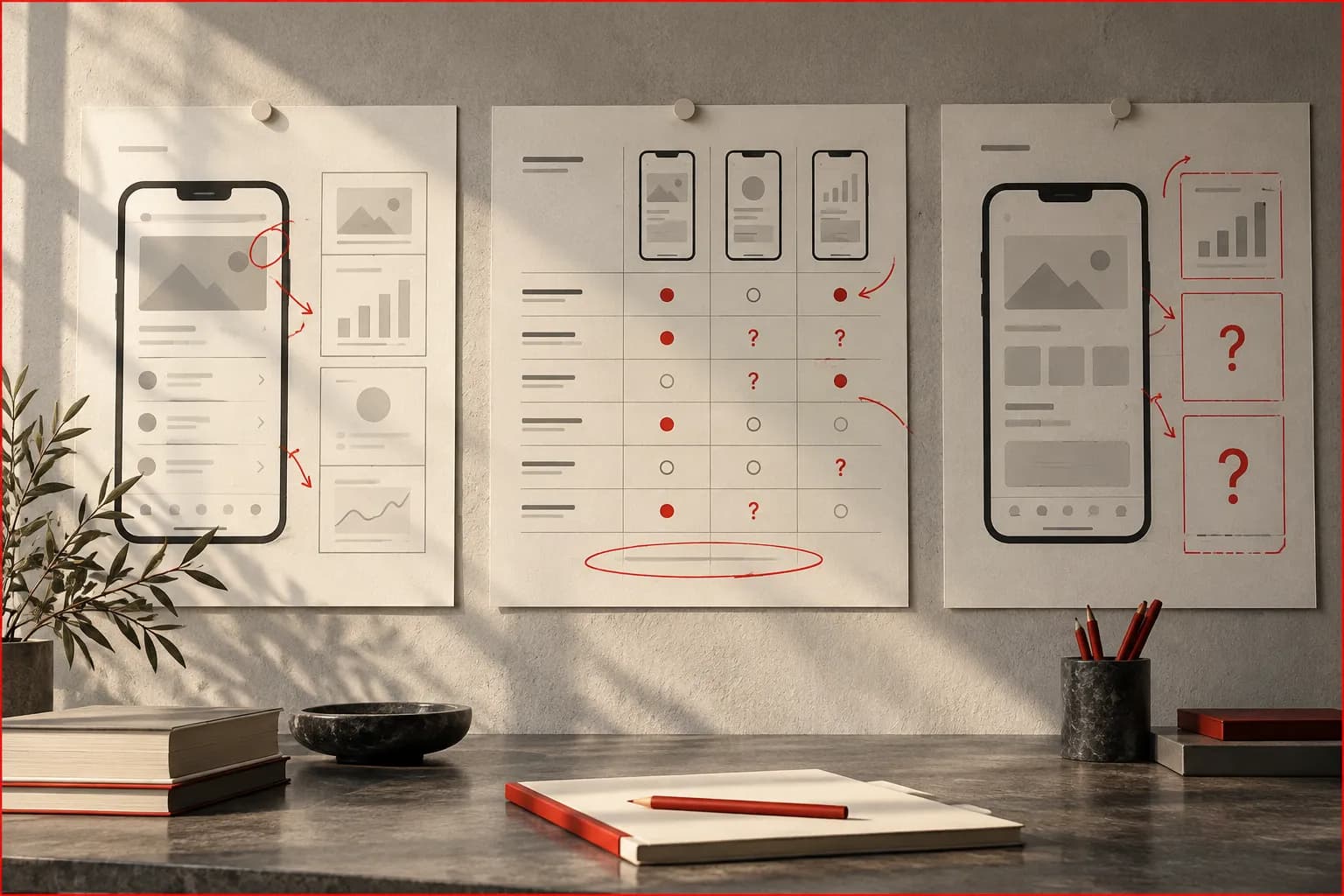
- Create three competitor observations, or use clearly labelled fictional alternatives. Record source, locale, date, audience, claim and visible evidence.
- Write one uncertainty and one positioning decision for each observation. Separate “not observed” from “not supported by the product”.
- Export the matrix and send one relevant non-brand phrase to the Workbench with its observation reference.
Your handover and assessment criteria
Your work is ready for review when each deliverable below can be understood without a verbal explanation. Include the source or product reference, the decision owner and any unresolved evidence gap. If a reviewer cannot verify a claim, record the missing evidence before treating the proposal as approved.
- Deliverable 1Dated competitor matrix with source references
- Deliverable 2Observed claims separated from inferences
- Deliverable 3Positioning decisions and pending keyword candidates
Check your understanding
A competitor ranks prominently and uses “best hiking app” in its description. Does that prove the phrase caused its ranking?
Read the interpretation
No. A public listing and an observed position do not establish causality. Record what you observed, assess the phrase against policy and product evidence, and avoid unsupported superiority claims.
Record your progress
Mark this lesson complete after checking your assignment against the handover criteria. Progress stays in this browser, separately from your tool project.
Sources and further reading
Platform references checked 30 September 2026.
App Store keyword research guide · Check final metadata fields